|

Every battery in an electric vehicle ages through a thousand small departures from ideal operating conditions. A cell runs slightly hotter than its neighbours. Another charges a fraction slower. A third experiences one too many high-current events. None of these deviations are significant enough to trigger an alarm on their own. Yet over hundreds, and eventually thousands, of charging cycles, they accumulate into something measurable: degradation.
By the time that degradation becomes visible, the battery has often been drifting away from optimal performance for months. The scale of that drift is far from trivial. Studies have shown that identical batteries operating in identical vehicles can age differently by as much as 30% under real-world conditions, influenced by factors as ordinary as ambient temperature, charging behaviour and driving patterns. The problem isn't sudden failure. It's thousands of invisible deviations accumulating long before anyone notices.
For India's commercial EV sector, those deviations compound much faster. Fleets in quick commerce, logistics and public transport often complete multiple charging cycles every day while operating through extreme temperatures, congested traffic and highly variable duty cycles. At the same time, the battery remains the single most expensive component in the vehicle, accounting for as much as 40% of its total cost. When degradation unfolds differently across every vehicle with little understanding of why, the battery stops being just another component. It becomes a critical business asset whose performance directly determines fleet economics.
What a Battery Management System Does
A battery pack is not a single energy source but hundreds of individual cells working together. No two cells behave exactly alike. Each responds slightly differently to charging, discharging and temperature, creating small imbalances that grow over time.
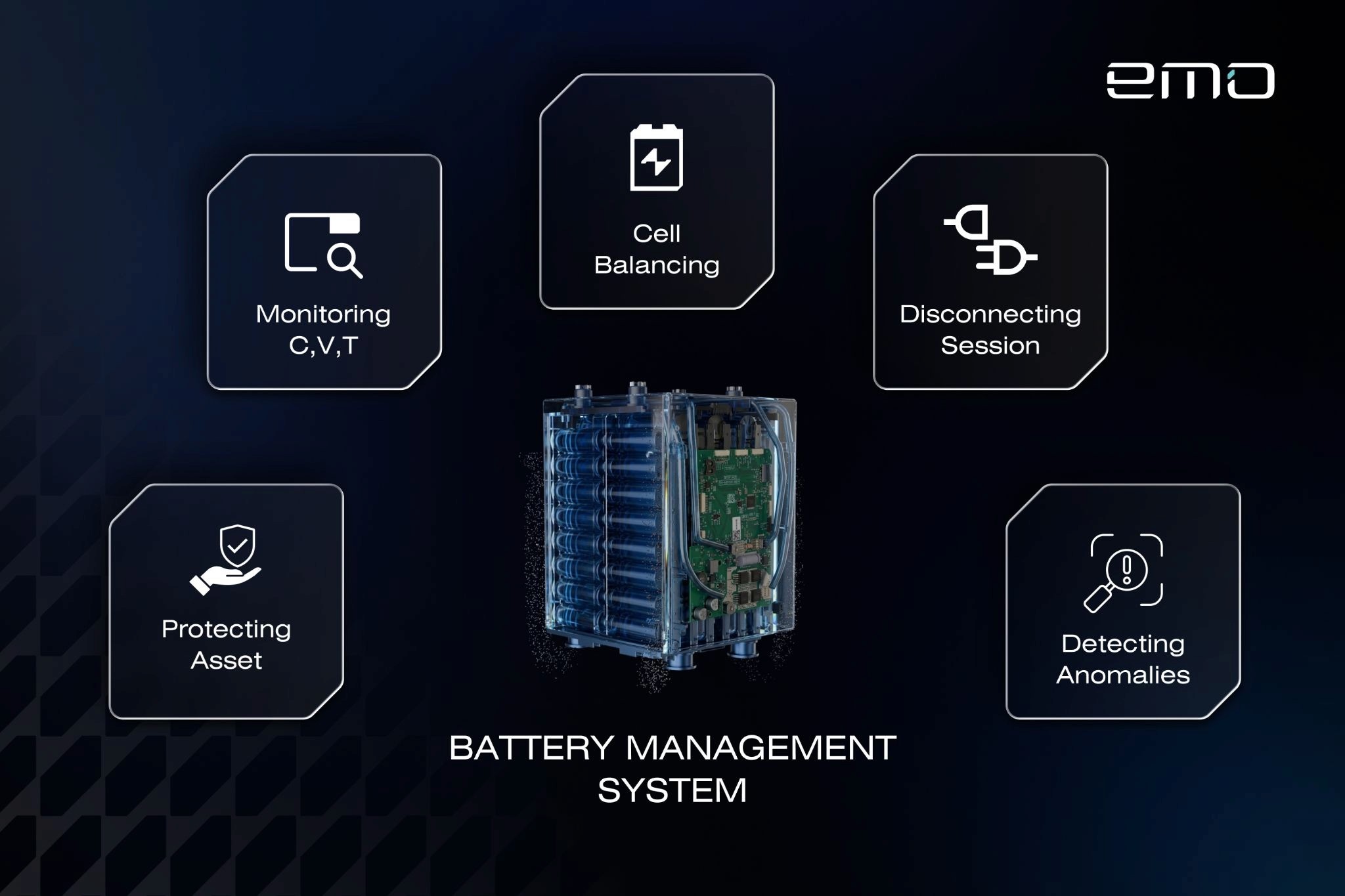
The Battery Management System (BMS) exists to manage that complexity. It continuously monitors parameters such as voltage, current and temperature, balancing cells, protecting against unsafe operating conditions and ensuring that the battery remains within safe limits. Every decision it makes is centred on the present moment. Monitor, protect, balance, detect, and disconnect are the fundamental duties of a BMS and it asks questions such as Is a cell too hot? Has a voltage limit been exceeded? Is it safe to continue operating? When the answer is no, the BMS intervenes immediately, and it should. Safety depends on that responsiveness.
But batteries rarely deteriorate because of a single event. They age through patterns that emerge gradually across hundreds or thousands of operating cycles. A system designed primarily to react to immediate conditions cannot, by itself, recognise those long-term behavioural patterns.
Beyond Monitoring: Building Memory into the Battery
The limitation isn't a lack of data. Modern BMS platforms already collect enormous amounts of it. The limitation is that most of those measurements are interpreted only in the context of the present moment. Protecting a battery is not the same as understanding how it is ageing. Closing that gap requires a system designed not only to observe, but to learn.
That is the principle behind SENS. Rather than replacing the BMS, SENS works alongside it. In addition to the measurements already available through the BMS, it combines data from embedded sensing and EMO's immersion cooling architecture to build a far richer picture of how every battery is behaving. These additional thermal and operational insights allow the system to observe changes that would otherwise remain invisible when viewed as isolated measurements.
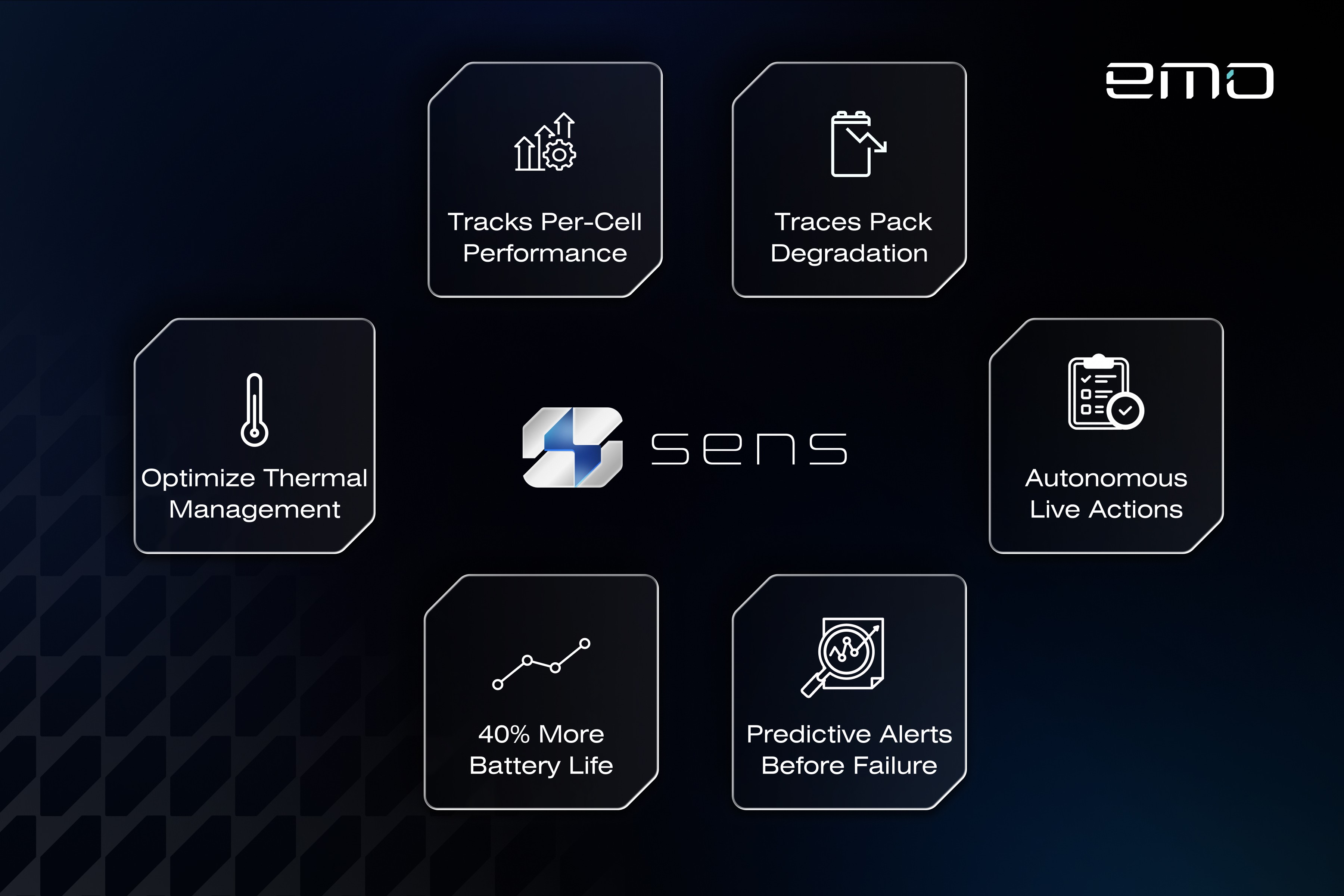
Machine learning is what transforms those observations into intelligence. Instead of asking only whether a battery is operating safely at this instant, SENS asks deeper questions. Which battery is ageing differently from every other battery operating under similar conditions? Which individual cell is quietly diverging from the behaviour expected for its chemistry, temperature profile and usage pattern? Which early signals consistently precede accelerated degradation?
Those answers cannot be derived from a single charging cycle or a single vehicle. They emerge only by comparing millions of observations across thousands of batteries over long periods of operation.
Today, SENS continuously learns from more than 150 million kilometres of real-world fleet operations across over 18500+ battery packs in service. Every charging cycle refines its understanding of what healthy behaviour looks like for a particular chemistry, operating environment and usage pattern. Rather than treating every measurement as an isolated event, the system continuously relates it to historical performance, fleet-wide behaviour and evolving degradation patterns.
The result is not simply more data. It is a continuously improving understanding of battery health, one capable of identifying abnormal behaviour early enough for corrective action to preserve long-term performance.
In practice, SENS transforms battery data into actionable intelligence, optimising performance, cooling, and cell longevity while detecting anomalies, analysing behavioural deviations, providing granular performance insights, and autonomously generating alerts for specific functions.
Evidence at Fleet Scale
If that intelligence is genuinely learning, its impact should be measurable.
Across EMO's deployed commercial fleets, battery packs monitored through SENS retain 96–98% State of Health after 20,000 kilometres, 90–92% after 50,000 kilometres, and 85–88% beyond 75,000 kilometres of high-frequency, multi-shift commercial operation.
During fast charging, cell temperatures remain within a tightly controlled 24–28°C range, even under ambient temperatures approaching 45°C.
These outcomes are not drawn from laboratory testing or isolated pilot deployments. They come from continuously observing the same batteries across thousands of operating cycles under real-world commercial conditions, learning what healthy battery behaviour actually looks like and identifying deviations long before they become operational problems.
Why This Matters
Once fleets reach scale, the battery stops behaving like a component and starts behaving like infrastructure: expensive, essential, continuously depreciating and deeply tied to operational performance.Managing that asset intelligently changes the economics of electrification. The benefits extend well beyond battery longevity:
Maintenance becomes planned rather than reactive because degradation is identified before it develops into failure.
Fleet availability improves as fewer vehicles are removed from service unexpectedly.
Battery health becomes continuously verifiable rather than estimated through periodic inspection.
Residual asset value becomes easier to defend because it is supported by longitudinal operational data rather than assumptions.
The Next Competitive Advantage
Battery chemistry will continue to improve. Cell manufacturers will increase energy density, reduce costs and introduce new chemistries. That race is far from over. But chemistry alone will not determine who succeeds in commercial electric mobility. The greater competitive advantage will belong to those who understand how batteries behave throughout their entire working life, not simply when they leave the factory, but across every charging cycle that follows.
The Battery Management System remains indispensable. It will always be the foundation of battery safety, and that responsibility is non-negotiable. Yet as commercial fleets continue to scale, safety monitoring alone is no longer enough. Knowing that a battery is healthy today is valuable. Understanding where it is headed, and acting early enough to change that outcome, is what transforms a battery from a component that eventually needs replacing into an asset that can be continuously managed.