|
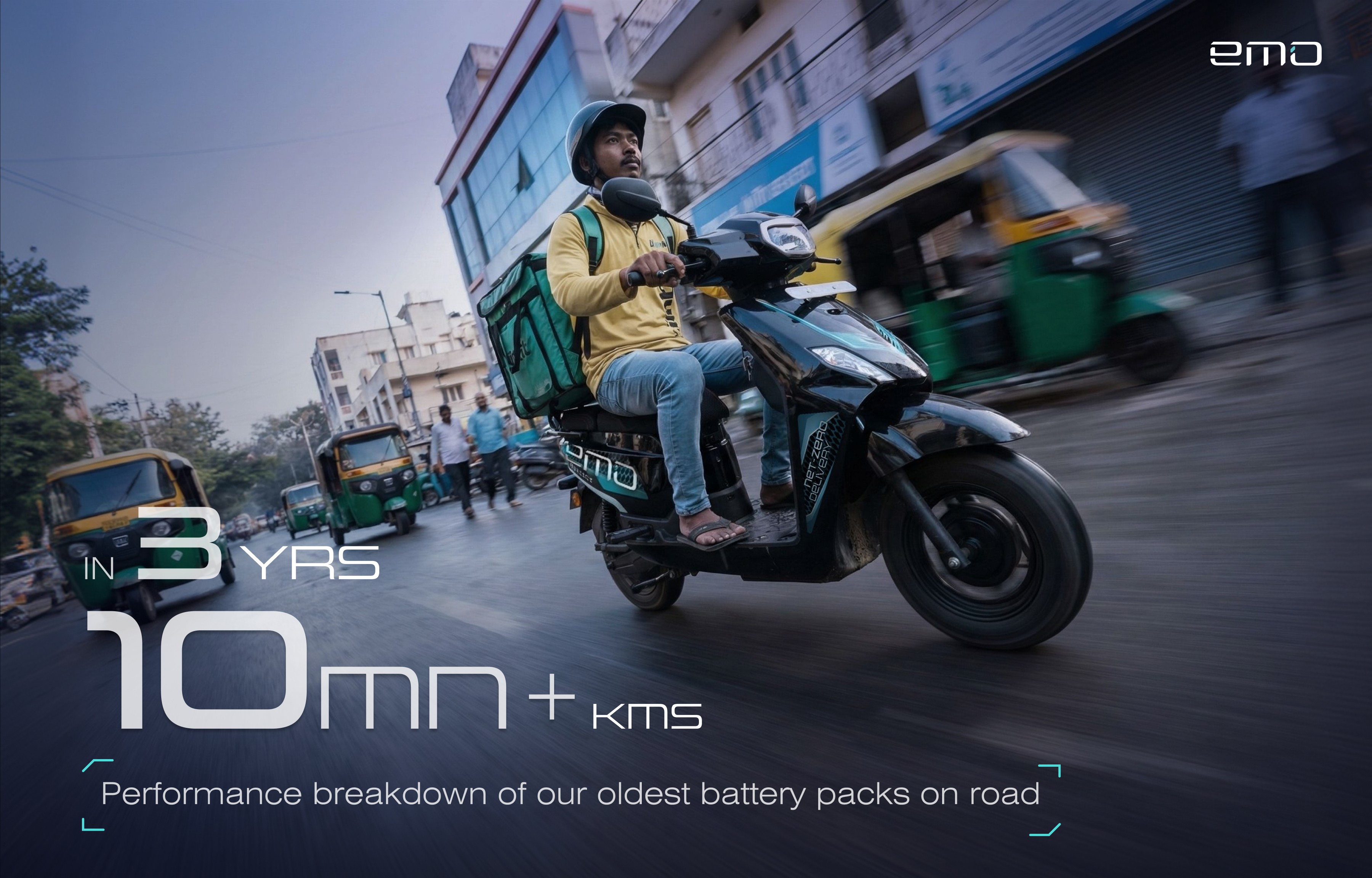
Over the past four years, EMO Energy has been building and deploying battery systems designed for high-utilization electric fleets. Today, some of our earliest battery packs have been operating in the field for nearly three years, powering delivery vehicles across cities like Bangalore and Gurgaon.
Many of these vehicles run daily quick-commerce routes, travelling close to 100 kilometers a day and relying on multiple short fast-charging sessions to stay operational.
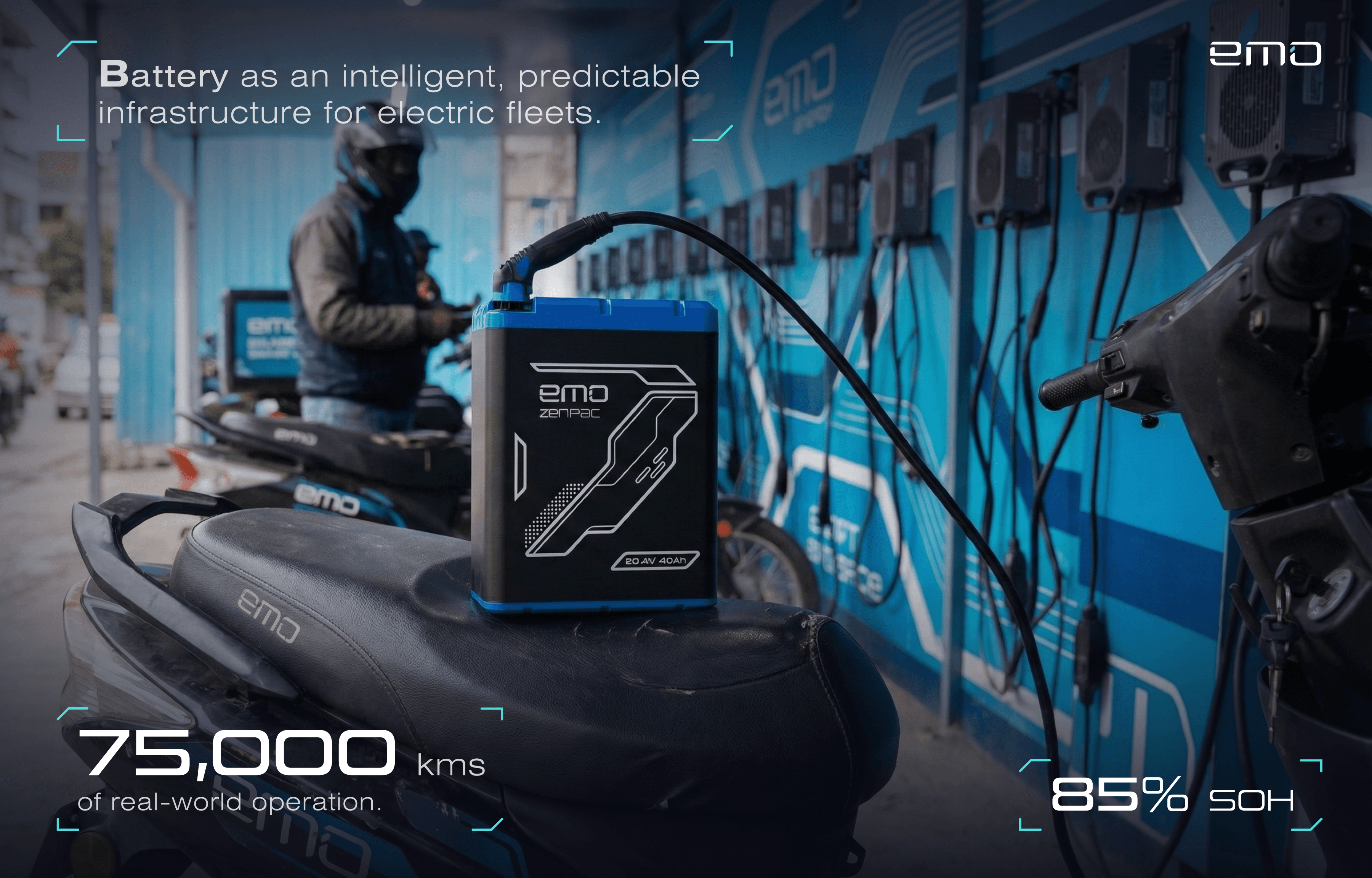
Over this time, a subset of these batteries has now crossed 75,000 kilometers of real-world operation, almost entirely powered through fast charging.
This long-term dataset offers something the EV ecosystem still lacks: real operational insight into how batteries behave under continuous fleet usage.
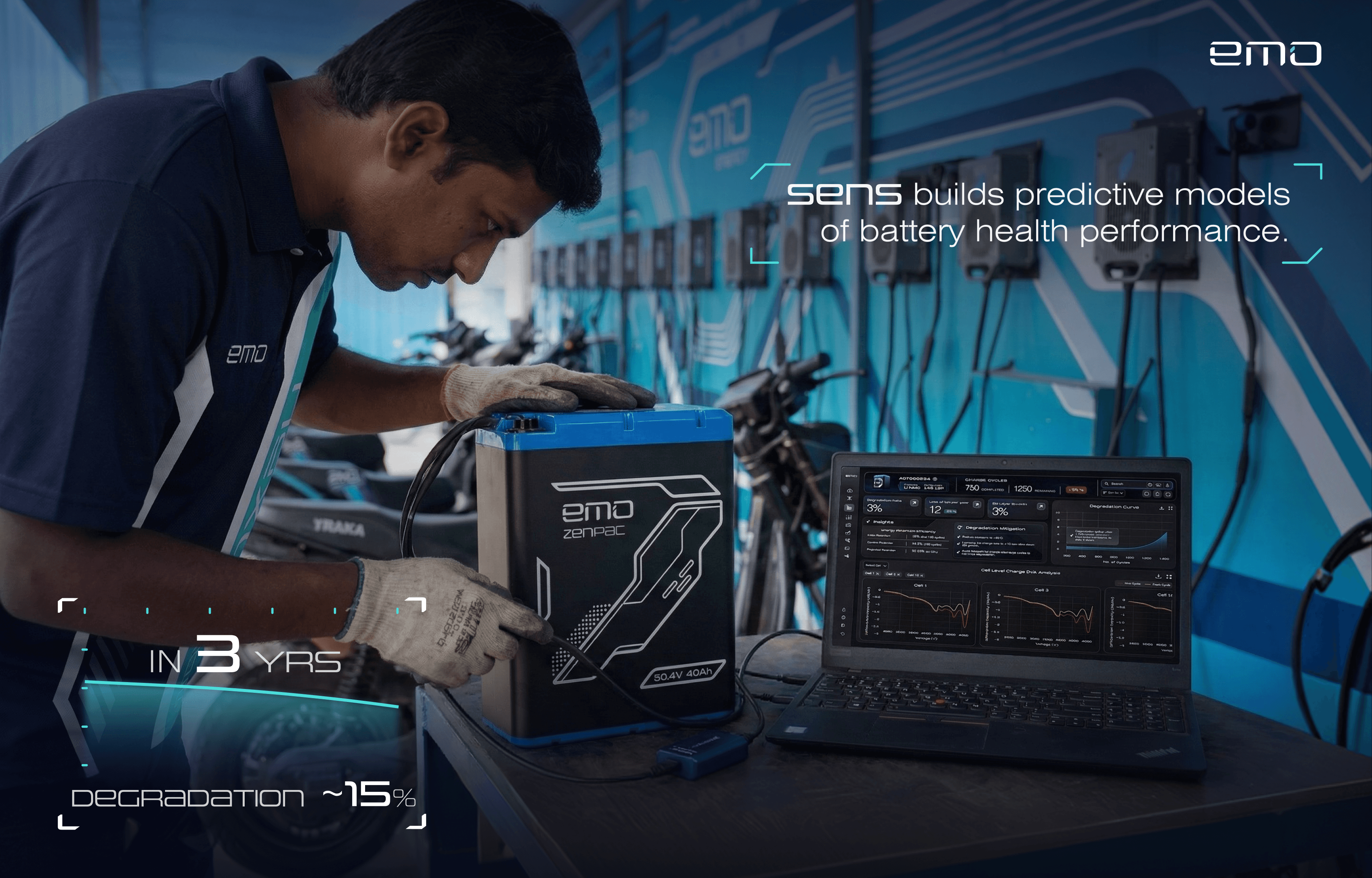
At EMO Energy, these insights are captured and analyzed through SENS, our battery health prediction and optimization platform, which continuously monitors battery behavior across deployments.
What this data reveals is an important shift in how we think about EV batteries not just as energy storage devices, but as intelligent, predictable infrastructure for electric fleets.
The Real-World Dataset
The data comes from 100 EMO battery packs deployed in commercial delivery fleets operating in Bangalore and Gurgaon.
These vehicles run in some of the most demanding operating conditions for EV batteries:
Daily distance: ~100 km per vehicle
Use case: Quick commerce deliveries
Charging behaviour: Multiple fast charges throughout the day
Climate exposure: Indian summers, monsoons, and winters
Peak temperatures: Over 45°C in Delhi summers
Unlike passenger EVs, these vehicles do not rely on overnight charging. Instead, they depend on frequent rapid charging sessions to maximize uptime.
Typical charging patterns look like this:
4–5 charging sessions per day
~5 minutes per session
~20 minutes of total charging per day
Battery capacity: 2 kWh
Fast charging power: 3.3 kW
0–80% charge time: ~20 minutes
For conventional battery systems, such frequent fast charging would typically accelerate degradation.
Yet the long-term data tells a different story.
What Happens After 75,000 Kilometers
Across the dataset, the oldest EMO battery packs have now crossed approximately 75,000 kms.
Despite operating under high utilization and daily fast charging, battery degradation remains limited.
Distance Travelled | State of Health |
20,000 km | ~96–98% |
50,000 km | ~90–92% |
75,000 km | ~85-88% |
This corresponds to roughly 15% degradation after 75,000 kilometers of real-world operation.
These vehicles continue to operate with over 85% battery capacity, even after three years of commercial deployment.
But the real insight lies not just in the numbers but in how the system manages the battery over time.
Typical degradation in conventional EV packs
Distance | Typical Degradation | SOH |
20,000 km | ~8–10% | ~90–92% |
50,000 km | ~18–22% | ~78–82% |
75,000 km | ~25–30% | ~70–75% |
In conventional battery systems operating under frequent fast charging, degradation of 25–30% by 75,000 kilometers is not uncommon. By comparison, the packs monitored through SENS in EMO’s deployments retained around 85% of their original capacity, despite operating under the same high-utilization conditions.
Why EV Batteries Need Intelligence
Battery degradation is rarely caused by a single factor. It is the result of many small stresses accumulating over time.
Charging too quickly when the battery is cold, operating in high ambient temperatures, repeatedly discharging the battery deeply, or pushing cells through hundreds of cycles under inconsistent conditions all of these gradually influence how a battery ages.
In real-world fleets, these variables change constantly. A vehicle may charge several times a day, operate through peak summer heat, and run unpredictable delivery routes that alter charging and discharge patterns.
Traditional battery management systems are designed primarily to keep the battery safe in the moment. They monitor temperature, voltage, and current, and intervene if something crosses a safety threshold.
But safety monitoring alone does not tell us how a battery will evolve over months or years of operation.
This is where predictive battery intelligence becomes important.
SENS, EMO Energy’s battery health prediction platform, continuously analyzes how batteries behave in the field. By combining telemetry from charging sessions, temperature profiles, cycle history, and usage patterns, the system builds a model of how each battery is aging.
Instead of simply reacting to battery conditions, SENS can anticipate how degradation is likely to unfold.
This enables the system to adjust charging behaviour and operational parameters, proactively reducing the stress on cells before long-term degradation accelerates.
In effect, the battery becomes a predictable energy asset rather than a black box, allowing fleet operators to maintain performance and reliability across thousands of vehicles.
How SENS Works
SENS acts as the intelligence layer across EMO battery deployments.
It continuously analyzes telemetry from each battery pack, including:
Cell voltage behaviour
Charge and discharge profiles
Temperature distribution
Cycle history
Usage patterns across fleets
Using this data, SENS builds predictive models of battery health performance.
This enables the system to:
Forecast battery degradation trajectories
Detect early signals of abnormal behaviour
Optimize charging profiles for longevity
Maintain performance consistency across fleets
In effect, SENS transforms the battery from a passive energy component into a predictable and optimizable energy asset.
Thermal Architecture Still Matters
Of course, predictive intelligence alone cannot compensate for poor battery design.
EMO batteries use a patented immersion cooling system, where cells are surrounded by a proprietary dielectric coolant circulating throughout the battery pack.
This approach enables highly uniform thermal management across cells, even during rapid charging.
In real-world operation, this keeps cell temperatures between 24°C and 28°C during fast charging.
Maintaining this narrow thermal range dramatically reduces the electrochemical stress that typically drives battery degradation.
Across the dataset, operating in Indian conditions that include 45°C ambient temperatures, there have been zero cases of thermal runaway.
What This Means for Quick Commerce Fleets
For quick commerce companies, electrifying delivery fleets is no longer just a sustainability decision, it is becoming an operational and economic one.
Delivery fleets in quick commerce operate under some of the most demanding utilization patterns in mobility today:
80–120 km of daily travel
Multiple short charging sessions across the day
Minimal tolerance for vehicle downtime
Operations in extreme urban heat and traffic
In this environment, two concerns often slow down EV adoption:
Battery degradation under frequent fast charging
Uncertainty around long-term battery health
Fleet operators worry that constant rapid charging could accelerate degradation and eventually lead to costly battery replacements or reduced vehicle range.
The field data from EMO’s deployments suggests that this risk can be significantly mitigated when batteries are designed specifically for high-utilization fleet environments.
Across vehicles operating in Bangalore and Gurgaon, many of which charge four to five times per day, battery packs have now crossed 75,000 kilometers while retaining over 90% state of health.
For fleet operators, this changes the economics of electrification.
Instead of treating batteries as fragile assets that degrade quickly under heavy use, they can become a predictable energy infrastructure powering thousands of deliveries every day.
Why Predictability Matters More Than Range
For quick commerce platforms, the most valuable metric is not maximum range, it is fleet uptime.
Vehicles must remain operational throughout the day while completing hundreds of delivery routes.
This is where systems like SENS become critical.
By continuously analyzing battery telemetry and predicting health trajectories, SENS allows operators to:
Monitor battery health across large fleets
Predict degradation before it impacts operations
Optimize charging behaviour automatically
Maintain consistent vehicle performance across years of operation
In effect, it transforms battery management from reactive troubleshooting into proactive fleet optimization.
For delivery companies operating thousands of vehicles, this level of predictability is essential to scaling fully electric fleets.
Building EV Fleets for the Quick Commerce Economy
India’s quick commerce ecosystem is expanding rapidly, with delivery volumes increasing year after year.
As fleets scale, electrification will depend not just on vehicle availability but on energy systems designed for high-frequency operation.
The early deployments monitored through SENS suggest that when battery systems combine:
robust thermal architecture
predictive battery intelligence
fast charging infrastructure
EV fleets can operate reliably even under continuous daily utilization.
For quick commerce companies planning the transition to all-electric fleets, this changes the question from:
“Can EV batteries survive high utilization?” to “How quickly can we scale them?”
Much of the EV conversation today focuses on vehicles and energy infrastructure. But as fleets electrify at scale and age, it’s becoming clear that something more is required.
Electric fleets need batteries that can withstand constant cycling, charging systems that minimize downtime, and intelligent platforms that ensure these assets remain reliable over years of operation.
Over the past four years, EMO Energy has been building across these layers. The results from our early deployments of batteries crossing 75,000 kilometers while retaining over 90% of their original capacity offer a glimpse of what’s possible when battery design, charging infrastructure, and energy intelligence work together.
Because the future of electric mobility will not be defined by batteries alone.
It will be defined by the energy systems built around them.